A. The Skills, Mindset and Executive Discipline Future CISOs Will Need
There was a time when being the person who understood the technology better than everyone else was enough to stand out in cybersecurity.
It isn’t anymore.
The next decade will demand something harder:
Leaders who can understand technology, interpret risk, influence business decisions and build trust at the same time.
The cyber environment is changing too quickly for leadership to remain anchored in yesterday’s playbook. AI is accelerating both attacks and defence. Geopolitical tensions are affecting cyber risk. Supply chains are becoming more interconnected. And organisations are being asked to innovate while simultaneously becoming more resilient.
The World Economic Forum’s Global Cybersecurity Outlook 2026 describes this as a landscape shaped by accelerating AI adoption, geopolitical fragmentation and widening capability gaps.
From my perspective as a technology and cybersecurity leader, this creates a very different career proposition.
The next CISO cannot simply be the person who knows security best.
They must be the person the business trusts when security, technology and growth collide.
B. The Cybersecurity Leadership Job Has Changed
Look at the questions executives are asking today.
They aren’t limited to:
- Is our network secure?
- Have we patched the vulnerability?
- How many incidents did we prevent?
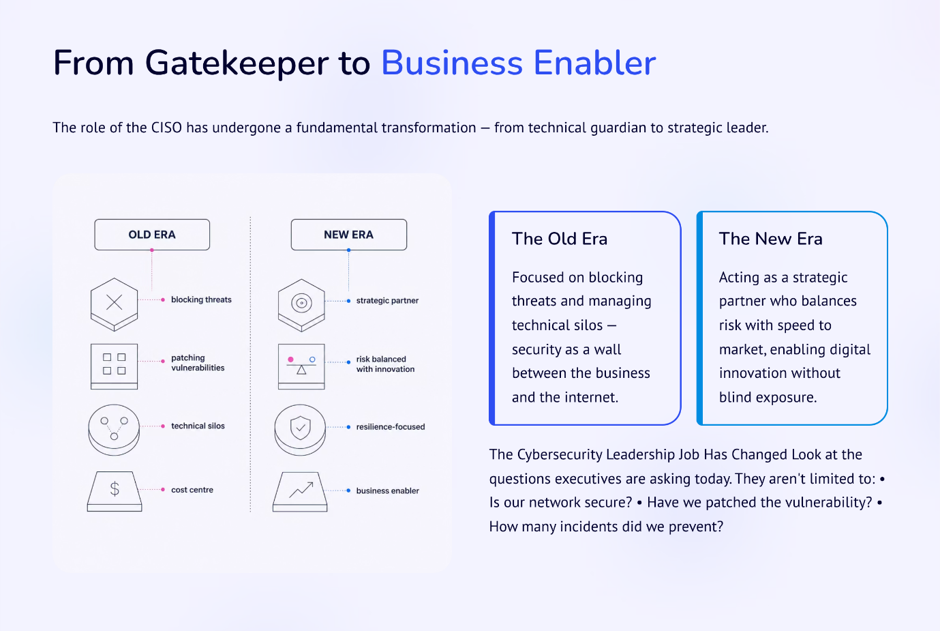
The questions increasingly sound like:
Can we safely deploy this AI capability?
What happens to the business if this supplier goes down?
How much cyber risk are we accepting to move faster?
Can our customers continue trusting us after an incident?
Are we investing in the right capabilities?
Those are business questions with cybersecurity consequences.
And that changes the definition of leadership.
A future security leader must be able to sit comfortably in a technical review in the morning and a boardroom discussion in the afternoon.
C. The Numbers Are Sending a Clear Signal
The skills challenge is already here.
The 2025 ISC2 Cybersecurity Workforce Study, based on responses from 16,029 cybersecurity professionals and decision-makers, found that skills shortages are increasingly more important than simply adding headcount. Nearly 95% of respondents reported at least one cybersecurity skills need, while 59% reported critical or significant skills needs.
And communication is not a minor requirement.
ISC2 found that 59% of cybersecurity professionals identified strong communication as an in-demand nontechnical skill, compared with 48% among hiring managers. Problem-solving and collaboration also ranked among the leading nontechnical requirements.
That tells me something important:
The industry doesn’t simply need more security professionals. It needs professionals who can think differently.
1. Learn to Think in Business Outcomes
This is probably the first transformation I would recommend to any aspiring cybersecurity leader.
Stop presenting security as a collection of controls.
Start presenting it as a business capability.
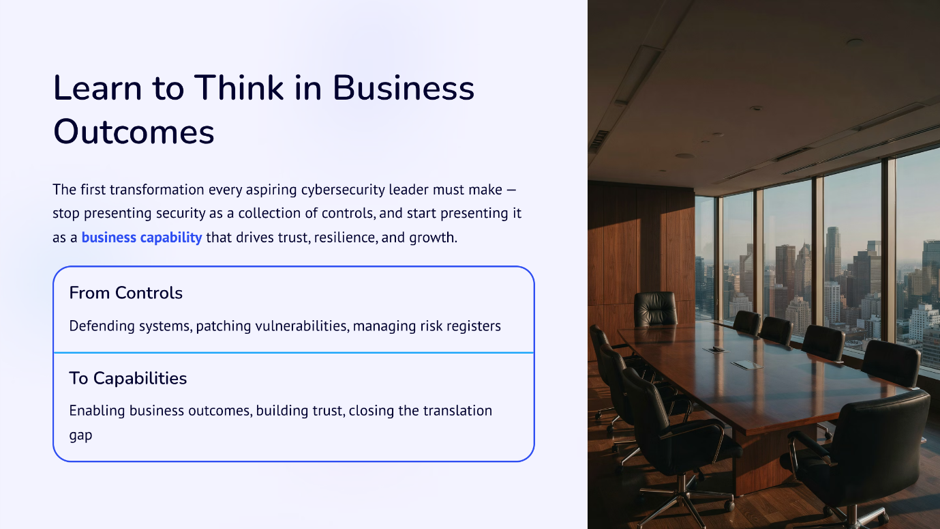
Instead of saying:
“We need stronger identity controls.”
Explain:
“This will reduce unauthorised access risk while allowing the business to onboard partners faster.”
Instead of:
“We need an AI security framework.”
Explain:
“Without governance, our AI expansion could introduce data exposure, accountability and regulatory risks.”
The difference is not vocabulary.
It’s perspective.
Future leaders should be able to connect cybersecurity with:
- Revenue
- Customer trust
- Operational resilience
- Regulatory exposure
- Business continuity
- Cost
- Innovation speed
If you cannot explain why security matters to the business, you are not ready to lead it.
2. Become AI-Literate-But Don’t Become AI-Blinded
AI will fundamentally change the cybersecurity profession.
The World Economic Forum’s 2026 research found that 94% of respondents expect AI to be the most significant driver of change in cybersecurity in the year ahead. Meanwhile, 77% of organisations are already using AI in cybersecurity operations.
But the same research reveals the leadership challenge.
54% of organisations cited insufficient knowledge or skills as a barrier to deploying AI for cybersecurity, while human oversight and uncertainty around risk were also significant concerns.
So future leaders need to understand two sides of AI.
AI as an accelerator
- Faster threat detection
- Automated analysis
- Improved response
- Better pattern recognition
- Reduced repetitive workload
AI as a new source of risk
- Data leakage
- Poor decisions
- Over-automation
- New attack surfaces
- Unclear accountability
- Agentic AI risks
The leadership question isn’t:
“Should we use AI?”
It is:
“Where should we trust AI, where should we constrain it, and where must humans remain accountable?”
That is an executive question.
3. Make Identity a Leadership Discipline
Identity is becoming one of the defining issues of modern cybersecurity.
The 2025 Verizon DBIR research found compromised credentials were an initial access vector in 22% of the breaches reviewed.
That matters because identity isn’t confined to employees anymore.
The enterprise now contains:
- Employees
- Contractors
- Customers
- Vendors
- APIs
- Applications
- Bots
- Machine identities
- AI agents
A future cybersecurity leader therefore needs to understand Identity Governance, not merely authentication.
The questions become:
Who has access?
Why do they have it?
Should they still, have it?
What is the AI agent allowed to do?
Who is accountable for that decision?
This is where cybersecurity meets governance.
4. Learn to Lead Without Authority
One of the hardest lessons in executive cybersecurity is this:
You rarely control everything you need to influence.
Security leaders depend on:
- Engineering
- Product
- Finance
- HR
- Legal
- Procurement
- Operations
- Executive leadership
You cannot simply instruct every function to change its priorities.
You need influence.
That means learning to:
- Build relationships before you need them
- Understand other functions’ priorities
- Negotiate risk intelligently
- Explain consequences without creating fear
- Build consensus
- Make disagreement productive
The future CISO is not a security dictator.
They are an enterprise integrator.
5. Replace Fear with Clarity
Cybersecurity has historically relied heavily on fear.
“This could be catastrophic.”
“The threat is critical.”
“We must act immediately.”
Sometimes those statements are justified.
But executives cannot make good decisions from fear alone.
A strong leader provides context.
Instead of presenting only the threat, explain:
What could happen?
How likely is it?
What would the business impact be?
What are our options?
What investment changes the risk?
What happens if we accept the risk?
This creates informed decision-making.
And that is what boards need from cybersecurity leadership.
6. Understand Cyber Resilience, Not Just Cyber Defence
Perfect security doesn’t exist.
That means future leaders must become exceptional at resilience.
The World Economic Forum’s 2026 outlook argues that cyber risk is now a strategic, economic and societal concern; not merely a technical one. It also emphasises the importance of resilience, governance, skills and collaboration.
A resilient leader asks:
If our defences fail, can the business continue?
That changes priorities.
You start thinking about:
- Recovery
- Crisis communication
- Business continuity
- Incident decision-making
- Third-party resilience
- Scenario testing
- Executive preparedness
The goal isn’t to promise that nothing will go wrong.
The goal is to make sure the organisation knows what to do when something does.
7. Build Executive Communication as a Core Skill
A future CISO may have five minutes with the CEO.
Or ten minutes with the board.
Those minutes matter.
The leader who can explain a complex cyber issue in three clear sentences has an advantage over someone who needs thirty slides.
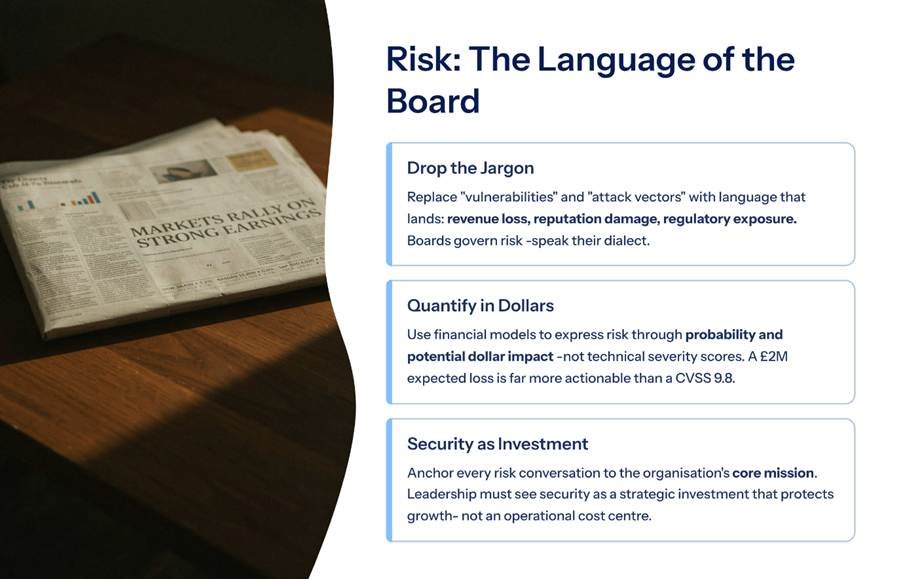
A useful executive structure is:
Risk → Business Impact → Decision → Recommendation
For example:
Risk: A critical supplier has privileged access to our environment.
Business impact: A compromise could disrupt operations and expose sensitive systems.
Decision: We can either accept the current exposure or reduce it through tighter access controls.
Recommendation: Reduce privileged access and introduce continuous monitoring within the next quarter.
That’s leadership communication.
Not technical theatre.
8. Develop Curiosity as a Competitive Advantage
Cybersecurity changes too quickly for anyone to remain an expert in everything.
Today’s emerging issue becomes tomorrow’s operational reality.
AI.
Quantum computing.
Machine identities.
Autonomous agents.
Digital sovereignty.
Supply-chain security.
Identity governance.
A future leader therefore needs intellectual curiosity.
Not superficial trend-chasing.
Real curiosity.
Ask:
What is changing?
Why is it changing?
What does it mean for my business?
What assumption are we making that may no longer be valid?
The strongest leaders I have encountered aren’t necessarily the people who know everything.
They’re the people who keep asking better questions.
9. Build Leaders, Not Followers
A cybersecurity organisation becomes fragile when everything depends on one person.
If the CISO is the only person who can make important decisions, the organisation has a leadership problem.
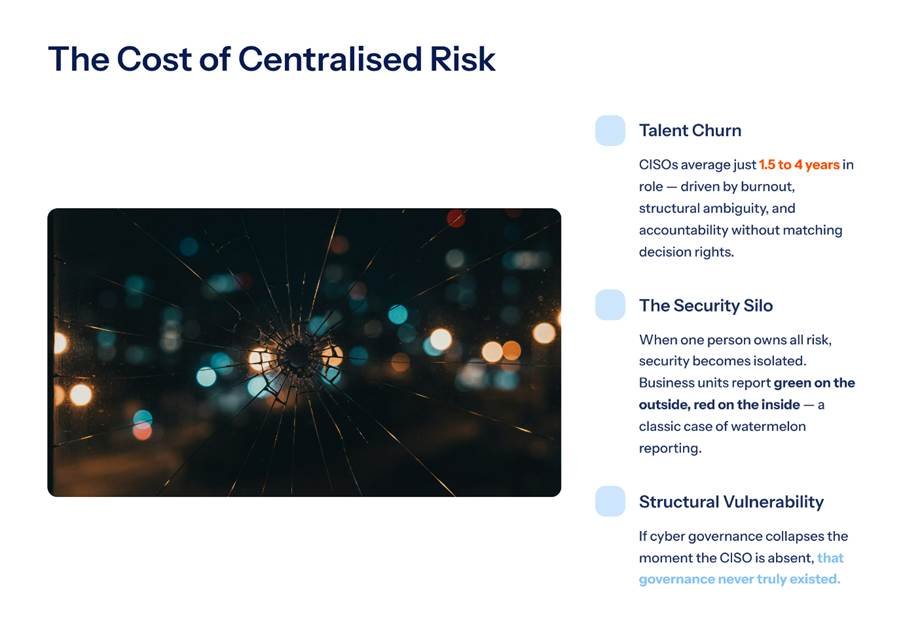
Future-focused leaders should deliberately build:
- Decision-making capability
- Succession plans
- Specialist expertise
- Cross-functional leadership
- Mentoring systems
- Knowledge-sharing cultures
Your legacy shouldn’t be:
“They were the smartest person on the team.”
It should be:“They built a team that became stronger because they were there.”
D. The Future Cybersecurity Leader: A Practical Scorecard
If you’re preparing yourself or someone on your team for a leadership role, evaluate these capabilities honestly.
| Capability | Future-ready question |
| Technical depth | Can I understand the technology well enough to challenge assumptions? |
| Business acumen | Can I connect cyber risk to business outcomes? |
| AI literacy | Can I assess both the value and risk of AI? |
| Identity governance | Can I govern human and non-human identities? |
| Communication | Can I explain complex risk in executive language? |
| Influence | Can I drive change without direct authority? |
| Resilience | Can I lead when prevention fails? |
| Strategic thinking | Can I anticipate rather than simply react? |
| People leadership | Can I build leaders who outperform me? |
| Curiosity | Am I continuously challenging my own assumptions? |
If the technical column is strong but the rest are weak, you’re not looking at a future executive yet.
You’re looking at a strong practitioner who still has leadership development ahead.
And that’s perfectly fine. Leadership is built.
E. What I Would Tell Someone Starting Today
If I were advising a young cybersecurity professional today, I wouldn’t tell them to collect every certification available.
I’d tell them to build five forms of capital.
1. Technical Capital
Know how systems work.
2. Business Capital
Understand how organisations make money and take risk.
3. Relationship Capital
Build credibility across functions.
4. Leadership Capital
Learn how to influence people and decisions.
5. Intellectual Capital
Develop a point of view about where the industry is going.
That combination is far more powerful than technical expertise alone.
F. The Next Decade Belongs to Translators
The cybersecurity leaders of the next decade will be translators.
They will translate:
Technology → Business
Threats → Decisions
AI → Governance
Risk → Investment
Security → Trust
Incidents → Resilience
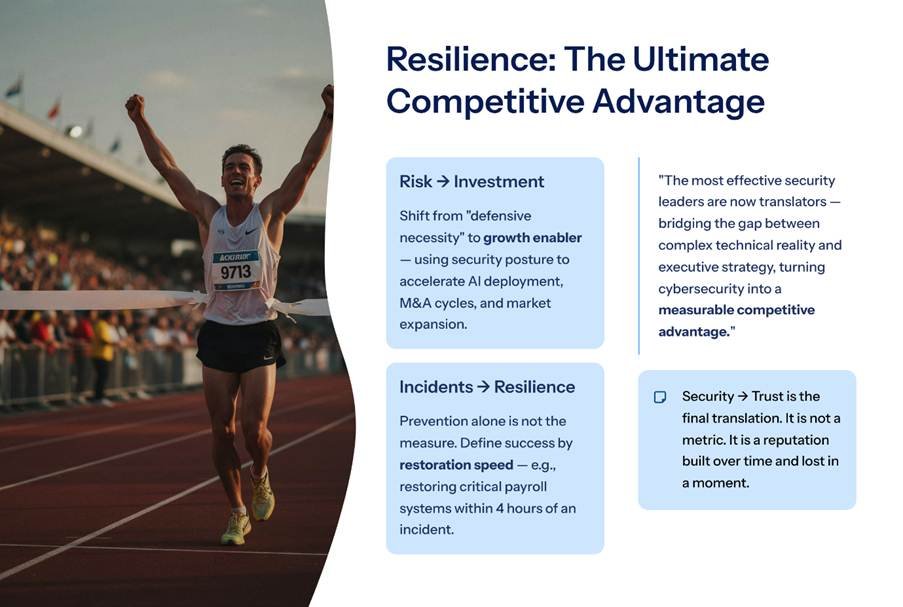
That is the leadership capability organisations will value most.
And the urgency is already visible.
In 2026, CEOs surveyed by the World Economic Forum identified cyber-enabled fraud and phishing as their leading cyber concerns, while AI vulnerabilities ranked second. CISOs, meanwhile, continued to prioritise ransomware and supply-chain disruption.
Notice the difference.
The CEO is thinking about financial and business exposure.
The CISO is thinking about operational security.
The future leader must understand both.
G. Don’t Prepare for the CISO Role. Prepare for the Executive Role.
The title will come later.
The mindset has to come first.
Cybersecurity leadership in the next decade will demand more than technical competence. It will demand judgment, communication, business understanding, AI literacy, identity awareness, resilience and the ability to bring people together when the stakes are high.
Technology will keep changing.
Threat actors will keep adapting.
AI will keep accelerating the pace.
The leaders who succeed will be those who can remain clear when everything around them is becoming more complex.
That is the real job.
Not simply protecting technology.
Protecting the organisation’s ability to trust, operate, adapt and grow.
And if I had to leave one message with the next generation of cybersecurity leaders, it would be this:
Don’t aim to become the person who knows the most about security. Aim to become the person the business trusts most when security matters.