



For years, organisations treated Identity and Access Management and cybersecurity as parallel disciplines. IAM handled who gets access. Cybersecurity handles how systems are protected. Different teams. Different tools. Different metrics.
That separation no longer holds.
Today’s most damaging cyber incidents don’t begin with malware or network breaches. They begin with compromised identities, excessive access, and trust that was granted once and never questioned again.
When identity becomes the attack surface, IAM and cybersecurity cease to be adjacent functions and become inseparable components of the same control system.
This is not a structural issue.
It’s a strategic one.
The Shift: Attacks No Longer Break In; They Log In
Recent industry analyses show a consistent pattern across breaches:
- valid credentials are misused,
- legitimate access paths are exploited,
- attackers blend into normal user behaviour.
In other words, security controls are bypassed without being attacked.
Firewalls, endpoint tools, and network controls still matter, but they cannot compensate for weak identity assurance or poor access governance. If identity is compromised, every downstream security control becomes reactive instead of preventative.
This is why IAM can no longer operate as a provisioning utility. It has become a core cybersecurity control.
Why the Old Organisational Model Is Failing
In many enterprises, IAM and cybersecurity still operate in silos:
- IAM focuses on onboarding, offboarding, and access requests
- Security teams focus on threat detection and incident response
The gap appears when:
- access is approved without understanding risk,
- privileged roles quietly accumulate,
- identity proofing is treated as a one-time event,
- Signals from IAM are not fed into security monitoring.
Attackers exploit this gap with precision.
Cybersecurity sees the incident.
IAM holds the root cause.
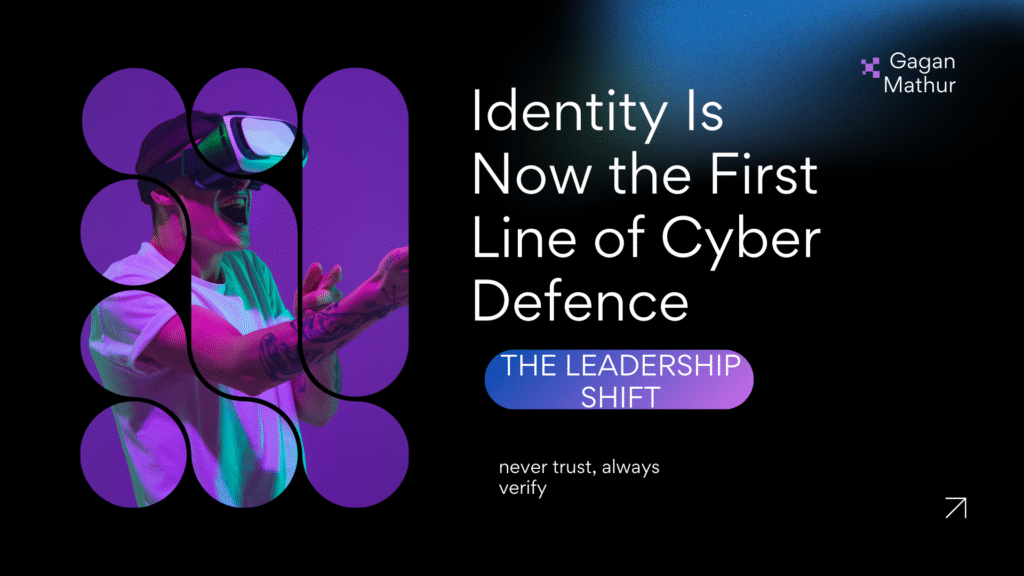
Identity Is Now the First Line of Cyber Defence
Modern cybersecurity has moved upstream.
Before a threat is detected, before an alert is triggered, before a response is initiated, identity decisions have already been made:
- Was this user strongly verified?
- Should this access still exist?
- Does this behaviour match historical patterns?
- Has trust been re-evaluated recently?
When IAM and cybersecurity are integrated, identity becomes:
- a preventative control,
- a continuous signal,
- a dynamic trust engine.
When they are separated, identity becomes a blind spot.
Zero Trust Fails Without Strong IAM
Zero Trust is often described as a cybersecurity strategy, but in practice, it is an identity strategy.
The principle is simple: never trust, always verify.
But verification cannot stop at login.
Strong Zero Trust requires:
- continuous identity confidence,
- context-aware access decisions,
- behaviour-based risk assessment,
- rapid privilege adjustment.
Without IAM embedded into cybersecurity workflows, Zero Trust remains theoretical; well-designed on paper, but fragile in execution.
Real-World Impact: Where Integration Changes Outcomes
Organisations that integrate IAM and cybersecurity consistently see:
- fewer identity-led incidents,
- faster incident containment,
- reduced blast radius from compromised accounts,
- improved audit outcomes,
- stronger user trust with less friction.
The reason is simple: security decisions are informed by identity context, not made in isolation.
This is not about adding more tools.
It is about aligning ownership, architecture, and intent.
The Leadership Shift Required
IAM and cybersecurity convergence does not happen organically. It requires leadership direction.
CXOs must stop asking:
“Do we have IAM and security covered?”
And start asking:
“Are identity decisions actively strengthening our security posture?”
That shift changes:
- how teams collaborate,
- how platforms are integrated,
- how success is measured,
- how trust is managed across the organisation.
IAM Is No Longer a Support Function
In today’s threat landscape, IAM is not an enabler sitting behind the scenes. It is:
- a risk control,
- a fraud deterrent,
- a trust framework,
- a cybersecurity multiplier.
Keeping IAM and cybersecurity separate creates delay, confusion, and exposure. Bringing them together creates clarity, resilience, and scale.
Future
The future of cybersecurity will not be defined by stronger perimeters or louder alerts.
It will be defined by how well organisations understand, manage, and challenge identity.
IAM and cybersecurity were never meant to operate apart.
The threat landscape has simply made that truth impossible to ignore.
Leaders who recognise this early will not just respond better to incidents; they will prevent many from happening at all.
