



For years, organisations tried to draw a clean line between Identity and Security.
Identity was about who someone was.
Security was about what systems were protected.
Different teams. Different budgets. Different dashboards.
That separation once felt logical. Today, it is increasingly artificial and dangerous.
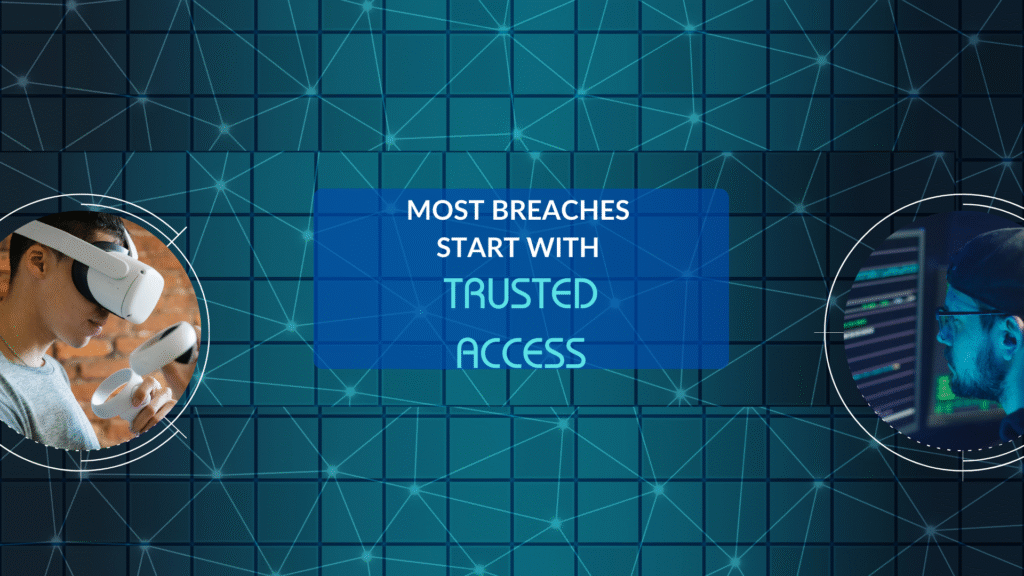
Because in the real world, most security incidents no longer begin where we think security starts.
They begin with Identity.
The Illusion of a Boundary That No Longer Exists
In theory, identity ends at authentication and security begins at enforcement.
In practice, that handoff is exactly where risk hides.
Recent enterprise incidents across industries show a repeating pattern:
- valid credentials are used,
- legitimate access paths are followed,
- security controls remain technically “intact,”
- damage unfolds quietly.
No firewall breach.
No malware alert.
No perimeter crossed.
The attacker doesn’t break in.
They belong, at least according to the system.
When that happens, asking where identity ends and security begins becomes the wrong question altogether.
What Real Incidents Are Actually Telling Us
If you look past headlines and into post-incident reviews, three truths consistently emerge:
1. Identity Is the Entry Point, Not the Afterthought
In many large breaches, the initial failure wasn’t detection; it was trust granted too early and held too long. Credentials remained valid long after context had changed. Privileges accumulated quietly. Behaviour drifted without challenge.
Security teams saw the activity, but without identity context, it looked normal.
2. IAM Owned the Data, Security Owned the Incident
In multiple cases, identity teams had signals:
- stale access,
- excessive privilege,
- abnormal access patterns.
Security teams had alerts:
- unusual activity,
- lateral movement,
- data access spikes.
But the two were not connected in time.
Identity knew why the access existed.
Security knew what was happening.
Neither could act decisively alone.
3. Zero Trust Failed at the Identity Layer
Organisations proudly claimed Zero Trust maturity; yet access decisions were still anchored to static identities. Verification happened once. Trust persisted indefinitely.
Zero Trust in name.
Implicit trust in practice.
The Real Answer: Identity Is Security’s First Control
In modern enterprises, identity does not sit before security.
It operates within it.
Identity decisions determine:
- what security policies apply,
- how alerts should be interpreted,
- when access should adapt,
- how fast incidents can be contained.
Without identity context:
- alerts lack intent,
- enforcement lacks precision,
- response lacks speed.
Security without identity is loud but blind.
Identity without security is informed but powerless.
Why This Is a Leadership Conversation, Not an Architecture Debate
The convergence of identity and security does not happen by buying another platform.
It happens when leaders:
- stop measuring IAM by ticket closure,
- stop measuring security by alert volume,
- and start measuring risk reduction through identity decisions.
The most resilient organisations I’ve seen didn’t ask:
“Who owns IAM and who owns security?”
They asked:
“Who owns trust, and how do we challenge it continuously?”
That question changes everything.
So, Where Does Identity End and Security Begin?
It doesn’t.
Identity is the context that gives security meaning.
Security is the enforcement that gives identity consequences.
They are not sequential functions.
They are interdependent controls in the same system.
Treating them separately is no longer a design choice; it is a risk posture.
Closing Reflection
The future of cybersecurity will not be decided by stronger perimeters or faster alerts. It will be decided by how intelligently organisations establish, maintain, and revoke trust.
And trust, today, lives at the intersection of identity and security; whether we choose to acknowledge it or not.
The organisations that accept this reality early won’t just respond better to incidents. They will quietly prevent many from ever happening.
