




For years, IAM success has been measured by activity:
How many users were onboarded?
How fast access was provisioned.
How many reviews were completed before audit deadlines?
Yet organisations are still dealing with:
- identity-led breaches,
- access sprawl,
- fatigued approvers,
- recurring audit observations,
- and rising operational cost.
That tells us something important.
Activity does not equal sustainability.
From a CXO perspective, the strategic question is no longer “Is IAM working?”
It is “Can IAM continue working without becoming a risk or a drain?”
That is where IAM sustainability KPIs matter.
The Hidden Pain Point Leaders Are Facing
Most executives I speak with share the same frustration:
- IAM dashboards look green
- Audits are passed; barely
- Tools are expensive
- Teams are exhausted
- Risk still feels unmanaged
The problem is not intent.
It is a measurement.
IAM programs often track volume metrics, not health metrics. And what isn’t measured correctly quietly decays.
Why IAM Sustainability Is Now a Leadership Issue
This is no longer an IAM maturity problem. It is a leadership measurement problem.
IAM has become foundational to:
- Zero Trust security
- Regulatory compliance
- Insider risk reduction
- Digital transformation
- Customer and employee trust
Yet many IAM programs are:
- over-engineered,
- under-adopted,
- manually dependent,
- and fragile under scale.
Sustainability means IAM can:
- operate consistently,
- adapt to change,
- reduce risk over time,
- and do so without increasing friction or cost.
That outcome requires the right KPIs.
What Most IAM KPIs Miss
Traditional IAM reporting focuses on:
- number of access requests
- review completion rates
- SLA adherence
These metrics answer “Did we do the work?”
They do not answer “Did the work reduce risk?”
Sustainable IAM KPIs must reflect:
- behaviour,
- quality of decisions,
- long-term access hygiene,
- and system resilience.
IAM Sustainability KPIs That Actually Matter
Below is a CXO-friendly view of common IAM pain points and the KPIs that turn them into manageable outcomes.
IAM Sustainability: Pain Point → KPI → Outcome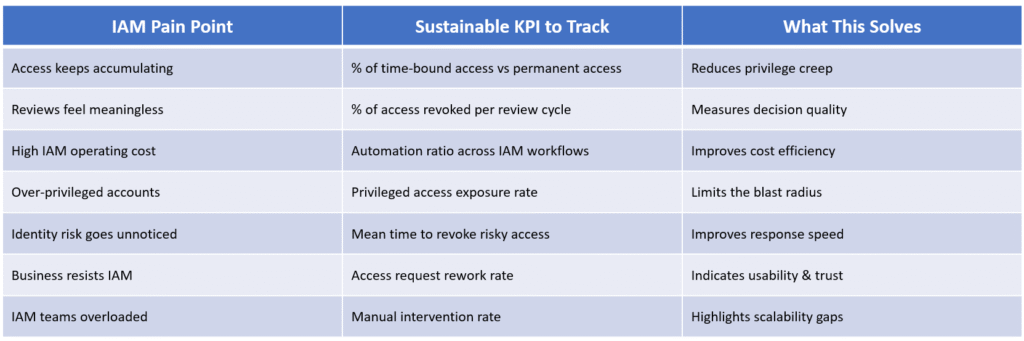
These KPIs shift focus from compliance theatre to risk reduction and resilience.
Real-World Insight: What Sustainable IAM Looks Like
Organisations with mature IAM sustainability metrics consistently show:
- fewer repeat audit findings,
- lower identity-led incidents,
- reduced access sprawl,
- improved business cooperation,
- and predictable IAM costs.
Not because they added more controls, but because they measured the right things.
The Leadership Shift Required
From a CXO lens, IAM sustainability requires asking different questions:
- Are we reducing identity risk year over year?
- Is access becoming cleaner, or just more automated?
- Can IAM scale without scaling headcount?
- Do business users trust IAM decisions?
When leaders ask these questions, KPIs change.
When KPIs change, behaviour follows.
Why This Matters Now
Identity-based attacks continue to rise globally.
Regulatory scrutiny is intensifying.
Digital access points are multiplying.
An IAM program that only survives audits, but not change, is a liability.
Sustainable IAM is not about perfection.
It is about controlled evolution.
Closing Perspective
IAM sustainability is not achieved by buying another platform.
It is achieved by measuring what keeps identity healthy over time.
In practice, the most resilient IAM programs are not the most complex ones, but the ones measured for sustainability from day one.
When KPIs reflect risk, behaviour, and resilience, not just activity, IAM stops being a maintenance burden and becomes a strategic control. That is when IAM truly supports the business instead of slowing it down.
If this resonates, you’re not alone.
Most organisations are rethinking how they measure IAM maturity.
The leaders who start with sustainability metrics today will avoid painful redesigns tomorrow.
