
Identity in Crisis, Trust at a Crossroads
Every sector today, healthcare, banking, and education, runs on identities. Yet the systems we rely on are stitched together with outdated databases, central authorities, and weak verification layers.
Data breaches are rising, cyberattacks are evolving faster than firewalls, and people are losing control over their personal data.
Enter Self-Sovereign Identity (SSI); the Web3-powered upgrade to digital identity that puts users back in control and helps enterprises reduce fraud, operational friction, and compliance burden.
What is SSI?
Self-Sovereign Identity = You own your identity, not a provider or a platform.
Instead of companies storing your data, SSI lets you store verifiable credentials in your own digital wallet, share only what’s required, and revoke access anytime.
This shift is massive, and it’s already being tested globally.
How Web3 Enables SSI: The Technology Layer
Web3 gives SSI the backbone it needs:
✔ Blockchain for trust: Ensures credentials can be verified without exposing personal data.
✔ Decentralised Identifiers (DIDs): A unique, non-traceable digital address you control.
✔ Verifiable Credentials (VCs): Tamper-proof identity documents (e.g., prescriptions, bank KYC, diplomas).
✔ Zero-Knowledge Proofs (ZKPs): Allows verification without revealing sensitive info.
This reshapes digital identity across industries.
SSI in Healthcare: The Cure for Identity Chaos
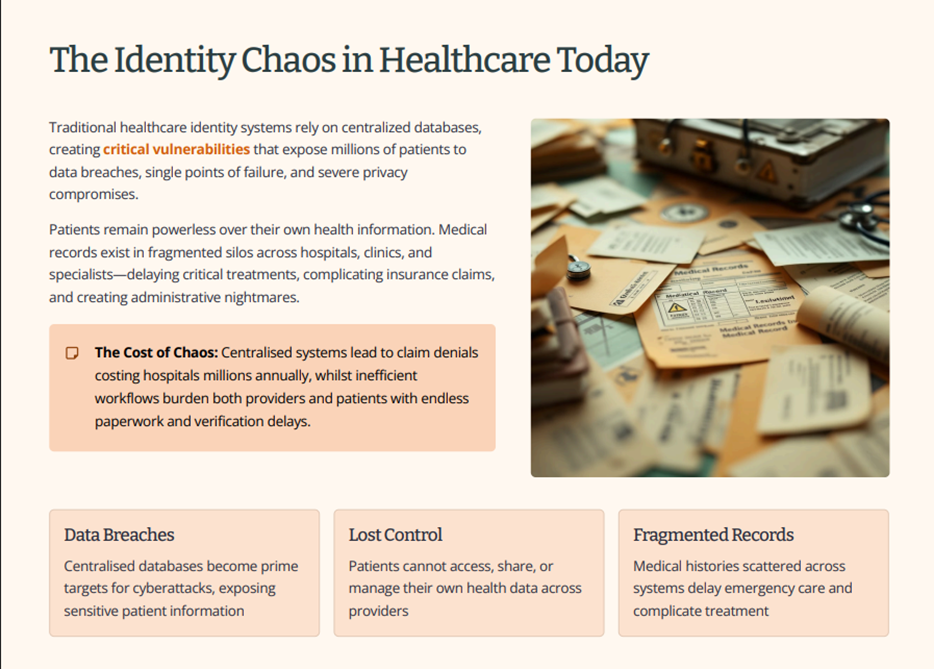
Healthcare is drowning in fragmented identity systems; hospital portals, lab portals, insurance portals, government health IDs… all separate, all vulnerable.
SSI becomes a single, unified identity layer.
🔑 Real-Time Use Cases
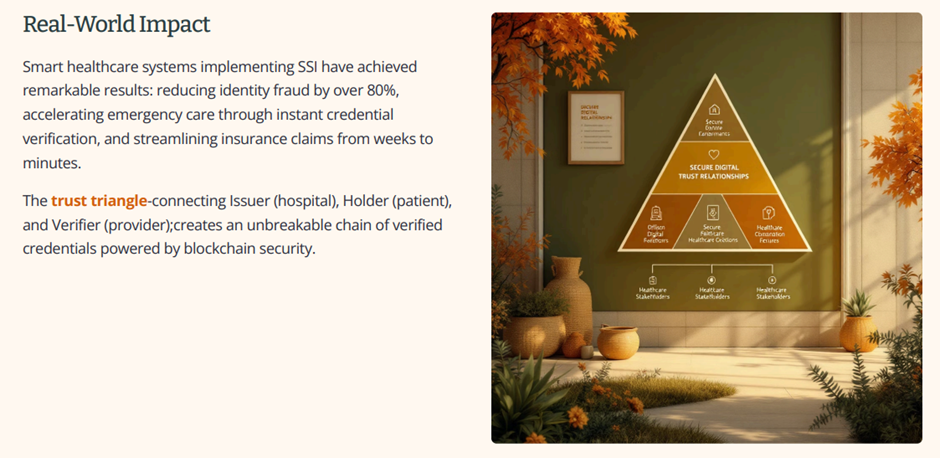
✓ Seamless Patient Identity Matching: Granular identity verification that eliminates mismatched or duplicate patient records.
Benefits:
- Accurate diagnoses
- Faster admission
- Cleaner EHR systems
✓ Portable Medical Records (Powered by Verifiable Credentials): Patients store their medical history in their digital wallet and share it when needed.
Instead of:
“Hunt for your old prescription.”
It becomes:
“Tap → Share → Verified.”
✓ Consent-Based Data Sharing: Patients grant or revoke access; true data privacy.
✓ Prescription Fraud Elimination: Prescription issued → Digitally signed → Shared securely → Verified instantly
Real-World Examples
- Estonia uses decentralised identity for nationwide digital health services.
- EU’s EUDI Wallet is piloting medical credentials for cross-border healthcare.
- US healthcare networks exploring SSI for provider credentialing.
SSI in Banking & FinTech: The Future of Fraud-Free Finance
The financial sector bleeds billions to fraud every year. With synthetic identities, deepfake KYC, and credential theft soaring, trust is collapsing. SSI disrupts this entire structure securely.
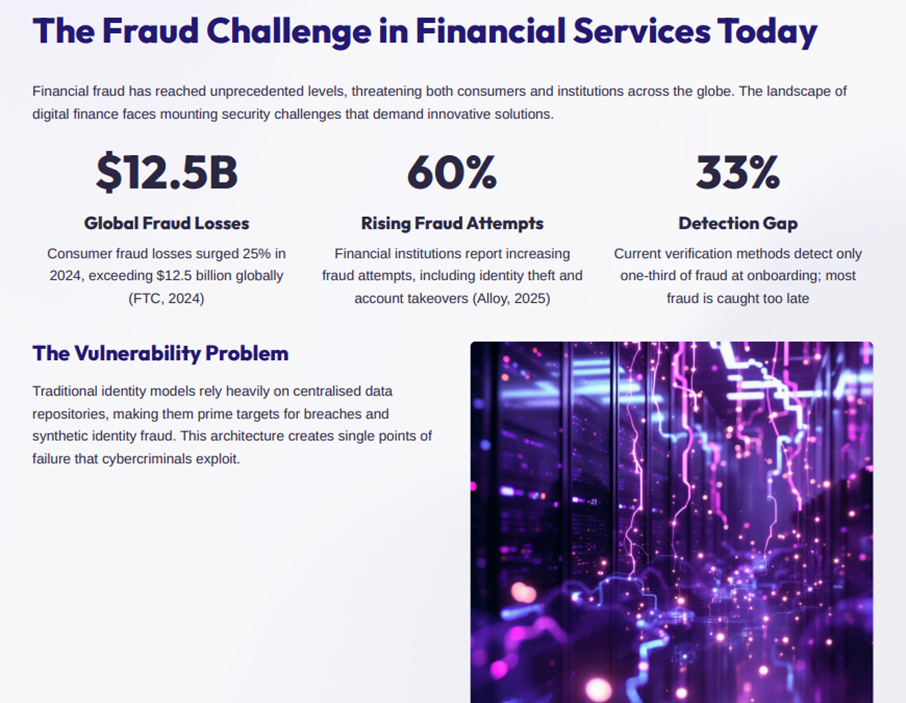
🔑 SSI Use Cases in Banking
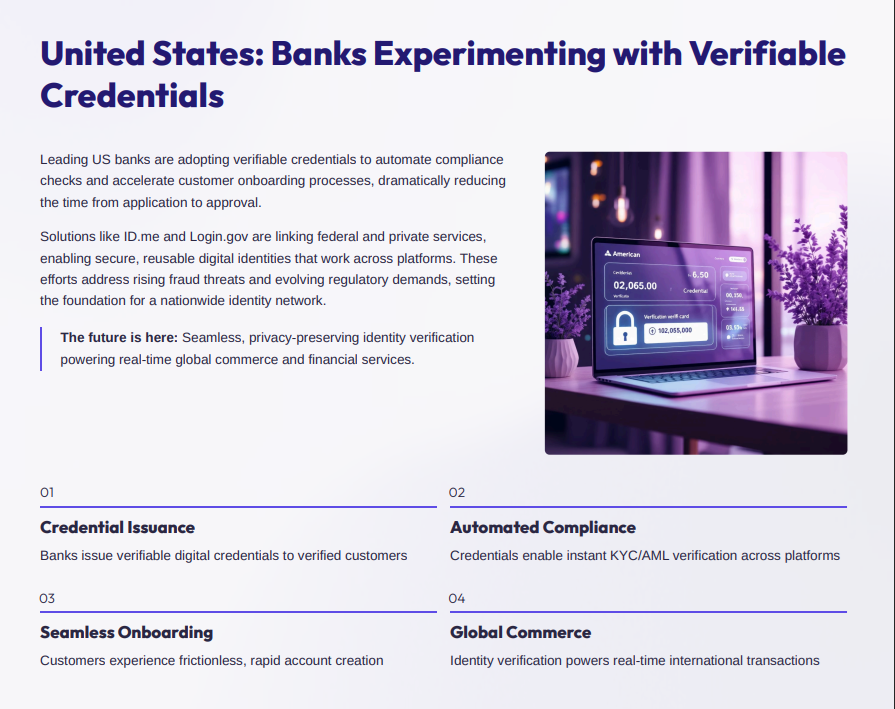
✓ Instant, Reusable KYC (The Biggest Game-Changer)
KYC done once → Encrypted → Reused across banks, insurance, fintech apps.
Impact:
- No repeated document uploads
- No manual verification
- Lower onboarding cost
- Higher customer satisfaction
✓ Fraud-Resistant Identity Proofing
SSI prevents:
- Synthetic identity fraud
- Account takeovers
- Loan application fraud
✓ Permissioned Financial Data Sharing (Open Finance 2.0)
Users share:
- Salary proof
- Tax records
- Credit scores
Only when needed, and revoke access instantly.
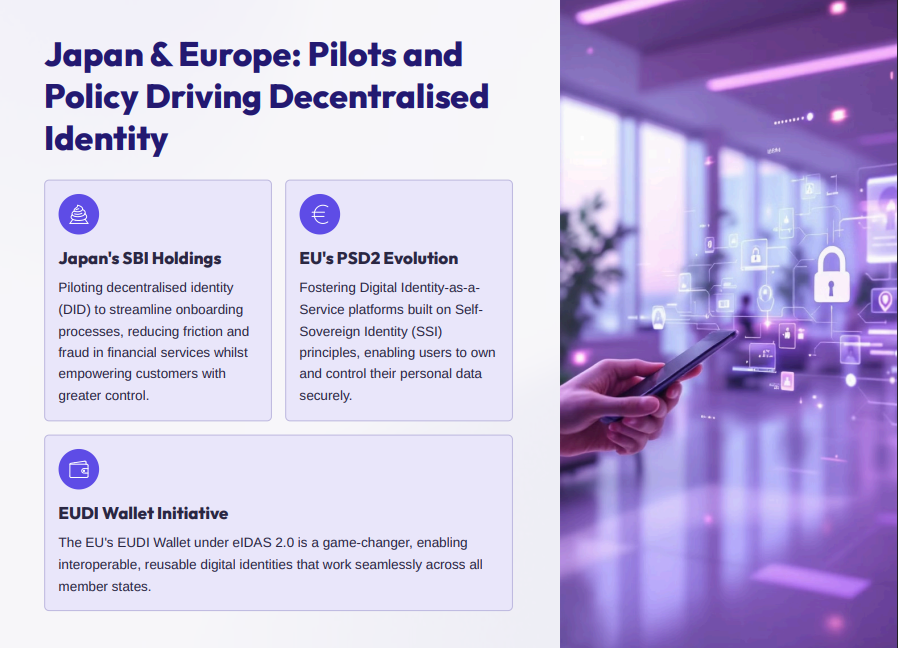
Real-Time Global Movement
- Japan’s SBI Holdings is piloting decentralised identity for onboarding.
- The EU’s PSD2 evolution encourages the development of digital identity-as-a-service built on SSI principles.
- US banks are experimenting with verifiable credentials to automate compliance.
SSI in Education: Ending the Era of Fake Degrees & Lost Certificates
The education sector is flooded with challenges: Fake degrees, manual verification, slow recruitment checks, and credentials scattered across institutes. SSI fixes all of this.
SSI Use Cases in EdTech & Academia
✓ Blockchain-Secured Digital Diplomas
Universities issue verifiable credentials directly to a student’s wallet.
No lost certificates, no illegal tampering.
✓ Automated Job Verification
Recruiters verify a candidate’s qualifications instantly; no calls, no emails, no paperwork.
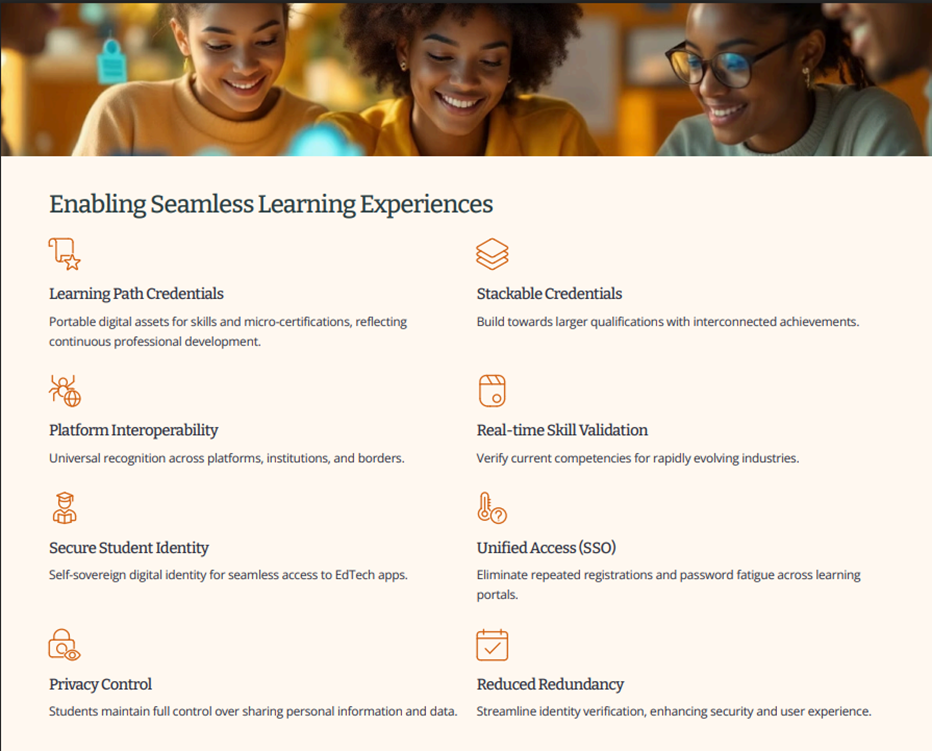
✓ Learning Path Credentials
Skill badges, micro-certifications, and training credits become portable across platforms.
✓ Secure Student Identity Across EdTech Apps
One identity, multiple learning portals; no repeated logins or data leaks.
Real Global Examples
- MIT, Stanford, and Harvard issue blockchain-secured diplomas.
- India’s DigiLocker is expanding toward verifiable, portable credentials.
- UNESCO & OECD support decentralised academic credentials globally.
- Education SEO Keywords: blockchain diplomas, EdTech identity, verifiable education credentials, student identity management
The Hidden Advantage of SSI: Trust Rebuilt at the Human Level
SSI isn’t just a “new identity tech”; it’s a philosophical shift:
🌱 People control their data
Not corporations.
🛡️ Privacy becomes default
Not an afterthought.
⚡ Verification becomes instant
Not a days-long manual process.
🤝 Trust becomes decentralised
Not forced through intermediaries.
This human-first approach is why SSI aligns seamlessly with modern regulatory frameworks like GDPR, eIDAS 2.0, India Stack, HIPAA, and PSD2.
- The global digital landscape is undergoing a massive transformation, with industries rapidly shifting toward digital-first ecosystems where identity, trust, and verification happen instantly and seamlessly across borders.
- What was once considered optional, virtual services, remote work, and cross-border transactions, has now become the backbone of everyday life. This shift has brought extraordinary convenience, but it has also exposed the vulnerabilities of outdated identity systems that were never designed for such scale or complexity.
- Today’s digital interactions demand authentication frameworks that are secure, interoperable, privacy-preserving, and resilient against evolving cyber threats.
Across every sector, we are witnessing a surge in digital experiences powered by real-time data, automation, and AI-driven personalisation. These experiences rely entirely on a reliable and tamper-proof digital identity layer that can support millions of users simultaneously without compromising on trust or security. Traditional identity models, centralised databases, repeated KYC processes, and platform-owned credentials are simply not equipped to match this pace.
Consider the everyday services now operating in a digital-first mode
Virtual banking
Customers open accounts, manage investments, and apply for loans remotely, demanding frictionless authentication without risking personal data exposure.
Telemedicine
Doctors need verified patient information, medical history, and consent in real time, while patients need assurance that their health data remains private and secure.
Remote learning
Educational platforms must confirm student identities, credentials, and access rights, especially with the rise of global online degree programs.
Global freelancing
Cross-border workers and clients rely on trusted identity proofing to avoid fraud, delays, and repeated verification cycles.
Distributed teams
Organisations depend on secure digital identities to grant precise, role-based access across apps, devices, and geographies.
Hyper-personalized services
AI-driven platforms deliver tailored recommendations, financial insights, and treatment plans; only possible when identity data is accurate, trusted, and user-controlled.
In this new era, Self-Sovereign Identity (SSI) has moved from being an emerging concept to becoming the foundational architecture of the secure digital economy. It empowers individuals to own and control their identity data while enabling institutions to verify information instantly without storing sensitive details. SSI eliminates redundant KYC cycles, reduces fraud, and strengthens data privacy; all while enabling faster, safer, and smarter digital interactions.
SSI is no longer a futuristic ideal; it is the backbone of trust that modern digital ecosystems urgently require.
Challenges in SSI Adoption (That We Must Acknowledge)
Even the best technologies face hurdles. Here are the biggest ones:
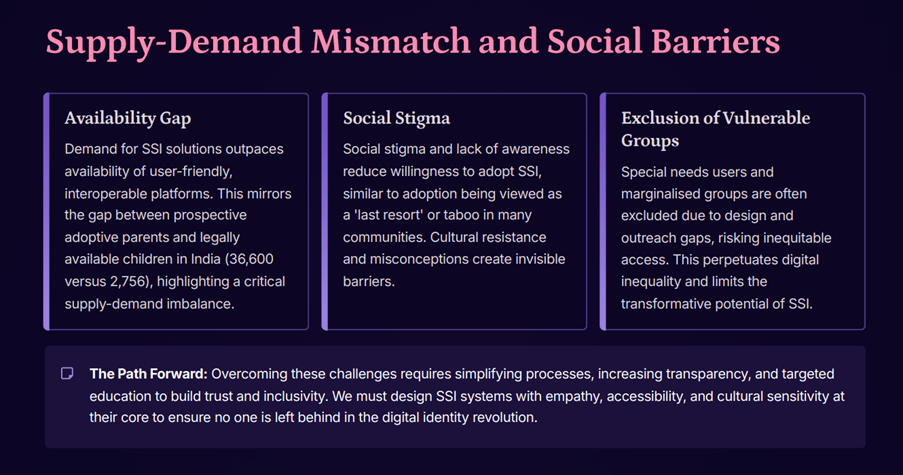
1. Lack of universal standards: Interoperability across countries and industries is still evolving.
2. Need for enterprise-level integration: Legacy systems must be adapted or upgraded.
3. User education: People need to understand and trust SSI wallets.
4. Regulatory clarity: Although improving, frameworks must fully support decentralised identity.
These are real challenges, but solvable.
And the global adoption curve is accelerating fast.
The Future: SSI as the Universal Identity Layer of Web3
Here’s what the next decade looks like:
• Every individual holds a personal identity wallet: Containing health records, financial credentials, education badges, digital citizenship, etc.
• Every business supports verifiable credentials: For KYC, onboarding, hiring, compliance, and audits.
• Governments adopt decentralised identity: As part of the digital public infrastructure.
• SSI merges with AI: For behavioural analytics, fraud detection, and zero-trust systems.
• IoT devices get identities: Cars, wearables, smart devices; everything will have verifiable credentials.
Conclusion: SSI Is the Trust Engine of Tomorrow
The shift towards Web3 Identity is not a trend; it is the foundation of the next digital era.
– Healthcare becomes safer.
– Banking becomes fraud-proof.
– Education becomes transparent and borderless.
SSI aligns security, privacy, and human empowerment in a single framework; something traditional identity systems have failed to achieve.
For organisations, adopting SSI today means:
- Lower fraud
- Faster onboarding
- Higher trust
- Regulatory alignment
- Future-proof architecture
- For individuals, it means:
- Privacy
- Control
- Portability
- Global access
Web3 Identity isn’t just the future of IAM;
It’s the future of digital civilisation.